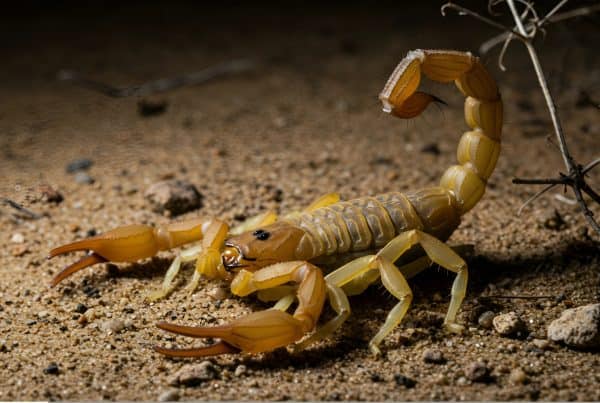

If you live in Mesa or the surrounding areas, you already know that summer brings the heat, the monsoons, and a noticeable uptick in unwanted visitors with stingers. Late spring through the end of summer is scorpion breeding season across the Valley, and few places feel it quite like the East Valley. The combination of older block-wall neighborhoods, irrigated yards, and new construction pushing right up against open desert makes our area close to ideal for the Arizona bark scorpion.
Here’s what’s actually happening out there during breeding season, why it tends to mean more scorpions inside homes, and what you can do to keep your family and pets safe.
When Is Scorpion Breeding Season?
In the low desert around Mesa and the surrounding communities, bark scorpions are active from roughly March through October. Things really pick up once nighttime temperatures stay above 70 degrees, which lines up with late spring and the long Valley summer. Activity tends to peak during monsoon season, generally July through September, when the extra humidity drives more insects to the surface and gives scorpions plenty to hunt.
Breeding fits right into that window. Scorpions mate in the warmer months, and after a gestation period that lasts several months, females give birth during summer. So the scorpions you’re seeing scurry across your patio in July aren’t just out looking for food and water. Many of them are part of a brand new generation that just arrived.
What Actually Happens During Breeding Season
Arizona bark scorpions have one of the stranger reproductive routines in the desert. It starts with a courtship “dance,” where the male and female grasp each other’s pincers and move together, sometimes for half an hour or more.
What makes scorpions unusual is that they don’t lay eggs. They give live birth. A single female typically produces somewhere between 25 and 35 young, often called “scorplings.” The babies are pale and soft when they’re born, and they immediately climb onto their mother’s back, where they ride for the first one to three weeks until their first molt. After that, they disperse and start living on their own.
This is why breeding season matters so much for homeowners. You’re not dealing with one scorpion. You’re potentially dealing with one female and a few dozen offspring spreading out across your yard, your block fence, and sometimes your home. If you spot a scorpion indoors during the summer, it’s worth taking seriously, because where there’s one, there are very often more nearby.
Why Breeding Season Means More Scorpions Indoors
Bark scorpions are built to get into places you’d never expect. Their flat bodies let them squeeze through a gap as small as 1/16 of an inch, about the width of a credit card. They’re also the only scorpions in the Southwest that can climb walls, trees, and rough surfaces, which is exactly how they end up on ceilings, in upper cabinets, and along the tops of block fences.
During breeding season, three things draw them toward your house:
Moisture. Scorpions are attracted to water, and yards across Mesa and the surrounding areas offer plenty of it. Irrigation drip lines, sprinkler boxes, pool decks, and the damp soil under shrubs all create the kind of humidity that scorpions and their insect prey love. Researchers have noted that irrigated landscaping in desert cities has driven scorpion populations up in some neighborhoods.
Shelter. Bark scorpions don’t dig deep burrows like other species. They prefer tight crevices, and our neighborhoods are full of them. Block-wall fences are a favorite, since the hollow columns inside give scorpions a cool, dark, protected place to hide and breed. They’ll also tuck into wood piles, rock features, wall voids, and the gaps around doors and windows.
Food. All those crickets, roaches, and other insects that thrive in summer are exactly what scorpions are hunting. A yard with a healthy bug population is a yard that can support a lot of scorpions.
What Makes the East Valley a Scorpion Hot Spot
Plenty of Arizona cities deal with scorpions, but a few local details make Mesa and the surrounding areas especially prone to them during breeding season.
Many neighborhoods here are built around block-wall fencing, and those walls are practically custom-built scorpion harborage. The hollow interior columns trap moisture and stay cooler than the surface, giving scorpions a safe place to gather, breed, and overwinter. It’s common to find groups of scorpions clustered in a single wall void.
The area also has a lot of newer development pressing into what used to be open Sonoran Desert. When construction disturbs scorpion habitat, those scorpions don’t disappear. They relocate, and the nearest house with a watered yard and a few entry points becomes the new neighborhood. Add in our intense monsoon season, when heavy rain pushes scorpions out of flooded hiding spots and toward higher, drier ground (often your home), and you’ve got a recipe for summer encounters.
Why Scorpions Deserve Extra Attention
A scorpion isn’t just a creepy nuisance like a cricket or an earwig. The Arizona bark scorpion is the most venomous scorpion in North America. A sting can cause intense pain, numbness, tingling, and in some cases vomiting, with symptoms that can last anywhere from 24 to 72 hours.
For most healthy adults, a sting is extremely painful but not life threatening. The bigger concern is young children, older adults, and pets, who can react more severely. If someone is stung and develops serious symptoms, especially a small child, contact the Arizona Poison Control Center right away at 1-800-222-1222 or seek medical care.
Because the stakes are higher with scorpions, prevention during breeding season is worth the effort.
What Homeowners Can Do
You can’t control the desert, but you can make your home a much less inviting target. A few practical steps:
- Seal entry points. Caulk gaps around doors, windows, pipes, and the foundation. Install or replace weatherstripping and door sweeps, since that 1/16-inch gap under a garage or exterior door is a common way in.
- Reduce clutter and harborage. Move wood piles, bricks, and landscaping rock away from the house. Clear out garage clutter and keep storage off the floor where you can.
- Manage moisture. Check irrigation lines and sprinkler boxes for leaks, and avoid overwatering near the foundation. Less standing moisture means fewer insects and fewer scorpions.
- Trim back the yard. Keep shrubs, trees, and grass trimmed and pulled away from the house so scorpions don’t have a bridge inside.
- Do a black-light check. Scorpions glow under UV light. A cheap black-light flashlight lets you scan your yard, patio, and block fences at night during the summer to see how active they are. It’s eye-opening, and a little unsettling.
These steps genuinely help, but they have limits during peak breeding season. Sealing your home doesn’t address the scorpions already living inside your block walls or breeding in your landscaping, and that’s usually where an infestation starts.
How Professional Treatment Makes the Difference
At Orange Pest Control, we’re bark scorpion experts, and scorpion season is exactly what our service is built for. Our Orange 360 Barrier targets the specific places scorpions hide and breed around homes in Mesa and the surrounding areas:
- A treated barrier around the foundation of your home
- Focused attention on entry points like doors and windows
- Sweeping webs and pests from eaves every visit
- Treating yard hotspots like irrigation drips, sprinkler boxes, and the areas under bushes and trees
- Block fence injections, where we treat the inside of each block fence column, since that’s where scorpions love to breed and gather
We use family and pet friendly, organically derived products with no odors or residues, so you can protect your home without worrying about what’s being sprayed around your kids and pets.
Frequently Asked Questions
Are scorpions worse in the summer? Yes. Bark scorpions are most active from late spring through early fall, and activity peaks during monsoon season from July through September. Warm nights and higher humidity get them moving, hunting, and breeding, so summer is when most people notice them around the house.
What attracts scorpions to my home? Three things, mostly: moisture, shelter, and food. Irrigation lines, sprinkler boxes, and damp soil draw them in, block-wall fences and clutter give them places to hide and breed, and a healthy population of crickets and roaches gives them plenty to eat. Reducing any of the three makes your home less appealing.
How do I know if I have a scorpion problem? Seeing one indoors is reason enough to pay attention, since scorpions often gather in groups and one usually means more are nearby. A black-light flashlight is the easiest way to check, because scorpions glow under UV. Scan your yard, patio, and block fences at night during the summer to see how active they are.
Are bark scorpion stings dangerous? For most healthy adults, a sting is very painful but not life threatening, with symptoms that can last 24 to 72 hours. Young children, older adults, and pets can react more severely. If someone is stung and develops serious symptoms, especially a small child, call the Arizona Poison Control Center at 1-800-222-1222 or seek medical care right away.
Can pest control actually get rid of scorpions? Scorpions are tougher to control than most pests, which is why a targeted, ongoing approach works best. Treating the places they actually hide and breed, like block fence columns, the foundation, entry points, and yard hotspots, knocks down the population and keeps it from rebuilding. That’s exactly what our scorpion service is designed to do.
Get Ahead of Scorpion Season
The best time to deal with scorpions is before breeding season hits full stride, but it’s never too late to take back your home. If you’ve spotted scorpions in your yard or inside this summer, don’t wait for the population to grow.
Call Orange Pest Control today at (480) 593-4850 to schedule your service, and ask about getting $50 off your first treatment. Whether you’re in Mesa or anywhere in the surrounding areas, let our scorpion experts help you enjoy your home this summer without the stingers.